

By Editor | Sep 24, 2025 | Categories: Business in China, China Internet, China Localization Strategies, China Marketing Channels, China Mobile Marketing, China Online Advertisement, Digital Marketing in China, Featured, Selling in China
Overview of Chinese Landing Pages
Building a Chinese landing page targeting visitors in China requires consideration of a set of market-specific guidelines in addition to the universal best practices for landing page creation.
First, let’s clarify the definition of a landing page (LP): it is the first page a potential customer lands on after clicking a link from search results, social media, or an email. A landing page with clear, focused design and easy-to-understand content is the key to converting visitors into customers.
Before we delve into the specific guidelines for Chinese landing pages, we need to ensure that the overall page structure complies with the best practices applicable to all types of landing pages.
Here’s a quick recap of the universal guidelines for all landing pages:
- Place a clear and concise headline at the top
- Strategically position a prominent call-to-action (CTA) button
- Use eye-catching and visually appealing images
- Ensure the main text clearly explains the product/service value proposition, following a general-to-detailed logic to guide visitors through the page
Next, we present the specific design requirements for Chinese landing pages, along with common mistakes companies make when creating them:
Chinese Landing Page Design: Do’s and Don’ts
1. Use Native-level Translation
While native-level translation should be a fundamental principle, a surprising number of foreign companies still cut corners on this aspect. Repurposing original landing pages for the Chinese market with machine-translated content or low-quality translations will render the landing page completely ineffective and even counterproductive.
Always hire professional translators to craft copy for your Chinese landing pages, and ensure the content is proofread by native Mandarin speakers.
2. Remove Links to Blocked Social Media Platforms
When repurposing landing pages for the Chinese market, many companies forget to remove links to their overseas social media accounts—which are inaccessible in mainland China. Retaining links to platforms like Facebook, Twitter, Google+, and Instagram will not only result in broken links and missing icons, but also significantly slow down the loading speed of your Chinese landing page.
Ideally, page loading time should not exceed 5 seconds. However, this goal is often challenging to achieve with overseas hosting (more details below).
3. Optimize Chinese Landing Page Loading Speed
Loading speed is almost always an issue for websites hosted outside China. It is important to note that without completing local business registration in mainland China, companies are not permitted to host servers within the mainland. In this case, the next best option is to rent servers in Hong Kong, China. Some Hong Kong-based hosting providers often advertise “fast China route” plans, which can improve access speed without the need for physical server deployment on the mainland.
Alibaba Cloud is a popular hosting solution that is cost-effective and easy to sign up for. However, when purchasing a hosting package, be sure to select Hong Kong-based servers.
4. Embed Videos from Local Platforms
Embedding videos on a landing page is often a good strategy, but YouTube videos will not play in mainland China (YouTube is among the blocked platforms).
The solution is to create an account on Youku—the Chinese equivalent of YouTube—upload your videos there, and link to them from your Chinese landing page. There is one caveat, though: videos on Youku are preceded by ads, which are notoriously long and can last up to 90 seconds. The only way to play videos without pre-roll ads is to subscribe to a paid Youku membership. While not cheap (currently RMB 5,000 per year), it is a worthwhile investment if you plan to host more videos on the platform in the future.
One final tip about videos: if your videos are in English, be sure to either produce a Chinese dubbed version or, at the very least, add Chinese subtitles.
5. Integrate Share Buttons and Links to Chinese Social Media
If you already have a presence on Chinese social media platforms such as Weibo, Youku, or WeChat, be sure to include links to these accounts on your Chinese landing page. For WeChat accounts, you can directly display the official account QR code. This not only demonstrates to visitors that you have established a local presence, but also helps drive more followers to your Chinese social media channels.
If you haven’t set up Chinese social media accounts yet, at the very least add Weibo and WeChat share buttons to the page.
6. Localize Contact Forms
If your Chinese landing page is designed to collect user data, ensure the contact form is fully translated into Chinese—do not leave any English field names to avoid confusing visitors.
Additionally, keep in mind that while English forms typically have separate fields for first and last names, Chinese forms usually only require one name field to accommodate both the surname (one character) and given name (one or two characters).
7. Optimize for Mobile
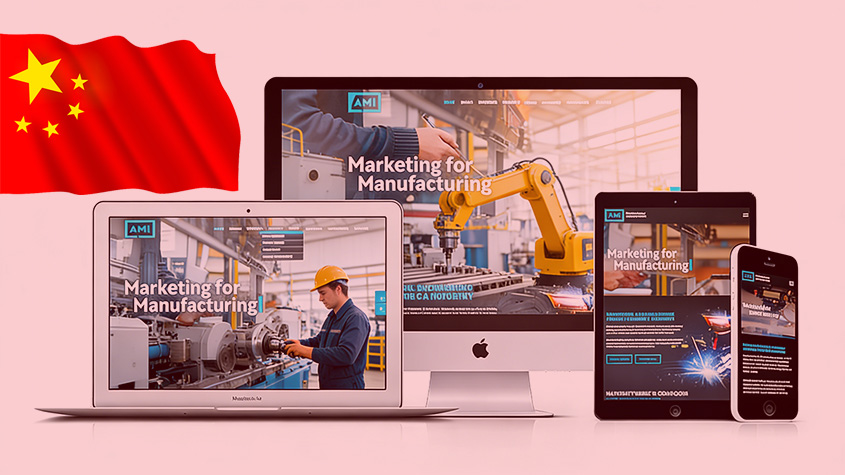
Mobile optimization is extremely critical for landing pages in the Chinese market, as the vast majority of traffic comes from mobile devices. Your Chinese landing page must adopt a responsive design to ensure it displays correctly on most mobile screens.
When the landing page is viewed on small mobile screens, it is essential to place key information such as the headline and CTA above the fold, rather than requiring users to scroll down to access them.
8. Test, Test, Test
Once your Chinese landing page is ready to go live, you might think you can sit back and relax—but that’s far from the truth. You can never be 100% sure that the page works correctly unless you, or someone on your behalf, test it from within mainland China.
Although there are online tools available to test the loading speed and accessibility of websites in China, they cannot be fully trusted—they fail to detect common issues such as display glitches and broken links. Therefore, the best approach is to have someone test your Chinese landing page in mainland China using browser developer tools (F12 shortcut in most browsers) to record any errors and loading times.
9. Provide Professional Translation Services
To further lower potential customers’ comprehension barriers and enhance localization experience, clearly offer multilingual translation support services on the landing page. Service scope can cover localized copy translation, product manual translation, customer service communication translation, etc., ensuring seamless language communication throughout the entire interaction between the enterprise and users. Meanwhile, emphasize that the translation team has industry-specific expertise and native-level expression capabilities to guarantee the accuracy and suitability of translated content.
10. Provide Compliant Data Management Services
In response to China’s data security and compliance requirements (such as the Personal Information Protection Law), the landing page should highlight professional data management services. This service can cover the entire lifecycle of compliant user data collection, storage, classification, and updating, helping enterprises avoid data-related compliance risks. At the same time, clearly inform users of data usage rules and security measures to strengthen their trust in the enterprise’s data management capabilities.
11. Provide CRM Data Integration Services
To help enterprises achieve efficient management and circulation of customer data, the landing page should explicitly offer CRM data integration services. It supports seamless import of user information collected by the landing page (such as form submission data and consultation records) into mainstream customer relationship management systems like Hubspot and Zoho CRM. The integration solution must ensure real-time and accurate data synchronization, avoid data redundancy or loss, help enterprises build comprehensive customer profiles, and improve customer follow-up efficiency.
12. Provide AI Chatbot Support Services
To enhance the real-time response experience for visitors, the landing page should be equipped with AI chatbot support services. This service enables 24/7 online Q&A, covering common scenarios such as product inquiries, after-sales support, and form guidance. Meanwhile, it supports localized customization of chatbot scripts to adapt to Chinese users’ communication habits, and seamlessly integrates with manual customer service systems to automatically transfer complex queries to human agents, ensuring service quality.